
If you’re serious about fintech marketing in Dubai, you already understand something important: Traffic is easy. Trust is not. Dubai is one of the fastest-growing fintech ecosystems in the GCC. According to the UAE Central Bank Financial Stability Report (2023), digital financial services and fintech innovation continue to expand rapidly across the UAE, increasing both opportunity and competition.
More fintech players entering the market means:
- Higher auction pressure
- Increased regulatory scrutiny
- More cautious consumers
- Longer onboarding cycles
In this environment, scaling without a trust architecture inflates cost.That’s why fintech customer acquisition in Dubai is less about traffic volume and more about credibility sequencing.
Understanding Fintech Marketing in Dubai Landscape
Dubai’s financial ecosystem is built around:
- Strong regulatory oversight
- Rapid digital adoption
- International banking exposure
- High per-capita income
Regulatory bodies such as:
- UAE Central Bank
- Dubai Financial Services Authority (DFSA)
- Virtual Assets Regulatory Authority (VARA)
Create an environment where compliance awareness is high. This directly affects digital marketing for fintech UAE brands. Because when trust sensitivity increases, conversion friction increases.
Why Fintech Marketing in Dubai Feels Expensive
There are four structural drivers behind rising fintech customer acquisition.
1. Compliance Visibility Expectations
Financial services ads UAE audiences expect:
- Transparent disclaimers
- Security assurance
- Regulatory clarity
- Data protection communication
Without visible compliance positioning, users hesitate. Hesitation reduces conversion rate. Reduced conversion increases CAC. This is why fintech marketing in Dubai must integrate regulatory credibility into funnel design.
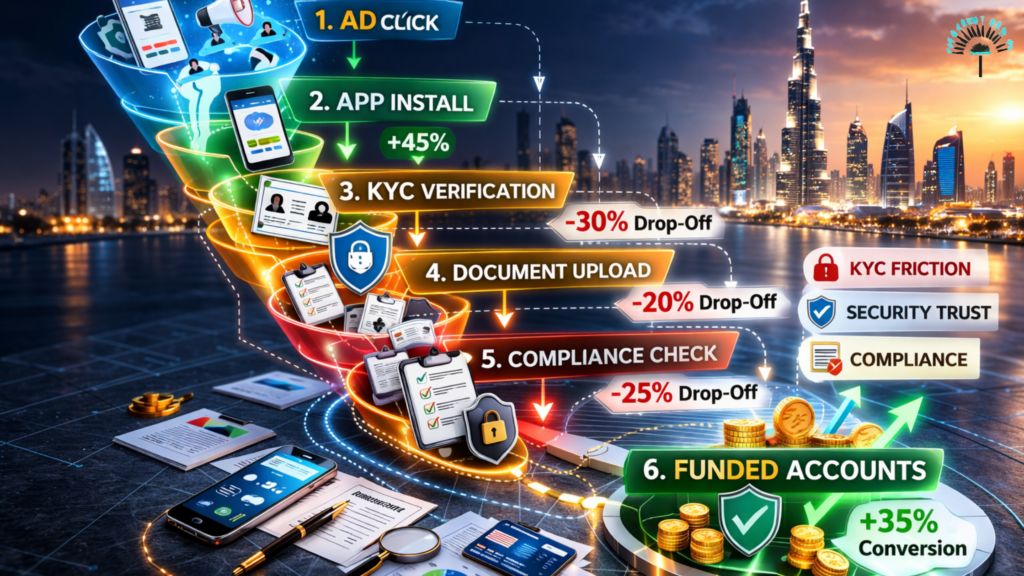
2. Multi-Step Onboarding Friction
Fintech funnels often require:
- KYC
- Identity verification
- Document uploads
- Risk acknowledgment
Each additional step increases abandonment probability. If onboarding is poorly optimized, the cost per acquired user escalates rapidly. In many cases, rising CAC is not an ad issue. It’s onboarding leakage.
3. Risk Perception Is Higher
Unlike e-commerce, fintech involves:
- Money
- Investments
- Financial decisions
- Personal data
This activates higher psychological caution. Dubai’s globally exposed audience compares platforms rigorously before committing. If your trust architecture is thin, traffic underperforms.
4. Premium Attention Economy
According to DataReportal UAE 2024:
- Internet penetration exceeds 99%
- Social media penetration exceeds 100%
Nearly every fintech target audience is digitally reachable. But so are competitors. This intensifies bidding pressure in finance-related categories. Yet again, CPM is not the root cause. Conversion depth is.
What Fintech Marketing in Dubai Gets Wrong
Many founders believe scaling equals:
More budget → More installs → More users. But in Dubai fintech, this formula collapses quickly.
Common mistakes include:
Mistake 1: Traffic Before Trust
Sending cold traffic directly to app install pages without:
- Case studies
- Founder visibility
- Media mentions
- Security assurance
Reduces conversion dramatically.
Mistake 2: Ignoring Middle Funnel Education
Financial products require explanation.
Effective digital marketing for fintech in the UAE must include:
- Educational content
- Risk transparency
- Benefit breakdown
- Trust reinforcement
Without middle-funnel reinforcement, retargeting costs escalate.
Mistake 3: Over-Optimizing for Cost-Per-Install
Installs don’t equal funded accounts.
In fintech, an acquisition must be measured by:
- Activated users
- Funded accounts
- Verified users
- Retention stability
Optimizing only CPI distorts the scaling strategy.
The Fintech Marketing in Dubai Growth Framework
To scale sustainably, fintech founders must adopt structure-first scaling.
Stage 1: Trust Compression
Before scaling ads, strengthen:
- Regulatory positioning
- Security clarity
- Authority signals
- Founder credibility
- Media mentions
Trust compression reduces evaluation time. Reduced evaluation time improves conversion.
Stage 2: Funnel Segmentation
Separate:
- First-time investors
- Experienced traders
- Corporate users
- Crypto users (if applicable)
Each segment requires tailored messaging. Generic fintech messaging performs poorly in Dubai.
Stage 3: Onboarding Optimization
Audit:
- Drop-off rate per step
- KYC friction
- Document upload UX
- App speed
- Confirmation messaging
Reducing onboarding friction often reduces fintech customer acquisition in Dubai more effectively than creative changes.
Stage 4: Retargeting & Education Loops
Effective fintech funnels include:
- Video explainers
- Case study ads
- Security reassurance messaging
- Authority-driven founder content
Retargeting builds familiarity. Familiarity builds confidence. Confidence drives activation.
Stage 5: Retention Architecture
Financial products depend on user activity.
Retention includes:
- In-app engagement nudges
- Educational emails
- Portfolio performance updates
- Transparent communication
Without retention design, acquisition becomes unsustainable.
Why Trust Architecture Drives Fintech Marketing in Dubai
Let’s simplify. If conversion improves from 1.5% to 3%, CAC drops significantly. In fintech, conversion is influenced more by trust than traffic quality.
That’s why fintech marketing in Dubai must prioritize:
- Psychological reassurance
- Compliance visibility
- Authority reinforcement
Before increasing media budgets.
Sector Nuances in Fintech Marketing in Dubai
Investment Platforms
Performance credibility and transparency are essential.
Over-promising damages long-term retention.
Payments & Remittance
Security reassurance and speed perception matter most.
Crypto & Web3
Education and compliance positioning are critical in Dubai’s regulated environment.

FAQs: Fintech Marketing in Dubai
Why is fintech customer acquisition expensive in Dubai?
Fintech customer acquisition in Dubai is expensive due to compliance friction, onboarding steps, trust sensitivity, and strong auction competition in financial categories. Chat with an Expert!
What is the most important factor in fintech marketing in Dubai?
Trust architecture is the most important factor. Regulatory clarity, security positioning, and authority signals directly influence conversion. Chat with an Expert!
How can fintech companies reduce CAC in Dubai?
Reduce onboarding friction, strengthen compliance visibility, segment audiences precisely, and focus on activation metrics rather than just installs. Chat with an Expert!
Is paid advertising effective for fintech in the UAE?
Yes, but only when supported by strong middle-funnel education, retargeting, and trust reinforcement. Chat with an Expert!
What metrics matter beyond CPI in fintech?
Key metrics include:
- Lifetime value
- Verified user rate
- Funded account rate
- Activation rate
- Retention rate
Chat with an Expert!
Final Perspective
Fintech growth in Dubai is not traffic-driven. It is trust-driven. If you increase the budget without increasing credibility, CAC rises. If you design architecture before scaling spend, acquisition stabilizes. Dubai rewards compliant, structured fintech growth.Not aggressive volume-first expansion. And in this market, trust always converts better than traffic.