If you’re investing in e-commerce marketing in Dubai, you’ve probably experienced this:
Traffic is steady. Add-to-carts are happening. Campaign metrics look fine.
But revenue feels inconsistent. That’s when founders start searching for answers around e-commerce conversion in the UAE. Here’s the reality: Dubai is not a low-intent market. It is a high-evaluation market. Conversion does not drop because people are uninterested. It drops because trust, structure, and sequencing are misaligned.
Let’s break down the real mechanics.
Understanding E-commerce Marketing in Dubai Environment
Before diagnosing conversion, understand the ecosystem.
According to Statista, UAE eCommerce Outlook 2024:
- UAE ecommerce revenue exceeds $8 billion annually
- High cross-border shopping behavior
- Strong premium and luxury consumption patterns
According to DataReportal UAE 2024:
- Internet penetration: 99%+
- Smartphone penetration: 97%+
This means: Almost every consumer is digitally reachable. But almost every consumer is also globally exposed.
Dubai buyers compare:
- International brands
- Regional alternatives
- Amazon pricing
- Noon pricing
- Direct-to-consumer pricing
That comparison pressure directly impacts the conversion rate of Dubai’s e-commerce.
Why E-commerce Marketing in Dubai Faces Conversion Drops
There are structural reasons behind this volatility.
1. Authority Gaps in E-commerce Marketing in Dubai
Dubai buyers validate brand legitimacy aggressively.
They look for:
- Reviews
- Google ratings
- Influencer alignment
- Press mentions
- Clear company presence
If your product pages lack visible trust indicators, conversion drops immediately. In D2C marketing in Dubai, authority signals are not optional; they are conversion drivers. Without visible trust, traffic becomes expensive curiosity.
2. Mobile Friction in E-commerce Marketing in Dubai
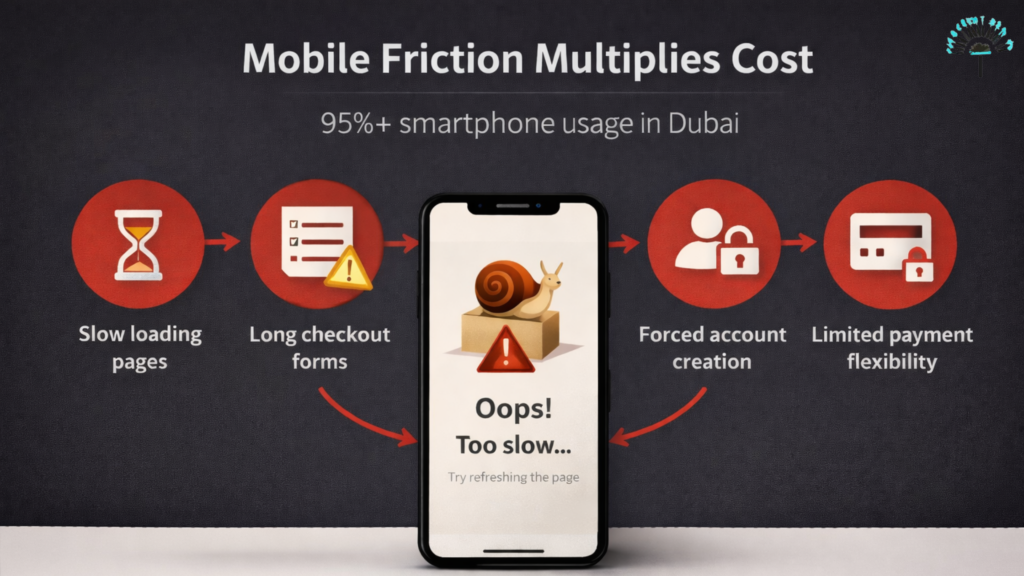
With 95%+ smartphone usage (DataReportal 2024), Dubai’s ecommerce is mobile-dominant.
Common friction points:
- Slow-loading pages
- Long checkout forms
- Forced account creation
- Limited payment flexibility
Even small UX inefficiencies reduce e-commerce conversion in the UAE significantly. In premium attention markets, users do not tolerate friction.
3. Payment Trust & Flexibility in E-commerce Marketing in Dubai
Dubai consumers expect:
- Apple Pay
- Google Pay
- Tabby / Tamara (BNPL)
- COD (in some segments)
If payment options feel limited, hesitation increases. Hesitation reduces conversion. Brands attempting Shopify growth in Dubai without optimizing local payment preferences underperform. The trust architecture is thin, and traffic underperforms.
4. Delivery Transparency Matters More Than Discounts
Many e-commerce founders assume price wins. In Dubai, perceived credibility often wins.
Consumers expect:
- Clear delivery windows
- Return transparency
- Local support reassurance
- Easy exchanges
If delivery messaging is vague, drop-off increases sharply. In e-commerce marketing in Dubai, fulfillment messaging directly impacts conversion rate.
5. Cold Traffic Pushed Too Aggressively
Many brands push:
Ad → Product Page → Checkout
That structure ignores Dubai buyer psychology.
Instead, effective sequencing looks like:
Ad → Category Exploration → PDP → Retargeting → Incentive → Conversion
Layering authority improves conversion stability.
6. Retargeting Depth Is Weak
Dubai buyers often:
- Browse
- Compare
- Leave
- Return later
Without layered retargeting:
- Dynamic product ads
- Cart abandonment emails
- SMS nudges
- Social proof retargeting
You lose second-touch conversions. Which inflates CAC.
Why Conversion Volatility Happens in E-commerce Marketing in Dubai
Dubai has a smaller addressable population compared to large countries.
This creates:
- Faster audience saturation
- Higher frequency inflation
- Creative fatigue acceleration
If authority is weak, minor creative shifts cause large performance swings. If authority is strong, performance stabilizes even with rising CPM. That’s why conversion architecture matters more than ad testing alone.
The Ecommerce Marketing in Dubai Conversion Framework
Here’s a structured approach for sustainable growth.
Stage 1: Trust Reinforcement Layer
Strengthen:
- Prominent reviews
- Verified testimonials
- Influencer mentions
- Local brand storytelling
- Clear return & exchange badges
Trust compression reduces evaluation friction.
Stage 2: Mobile Optimization Audit
Audit:
- Page speed (especially PDP)
- Check the checkout step count.
- Autofill integration
- Clear CTA visibility
Reducing friction often improves conversion faster than creative changes.
Stage 3: Payment & Delivery Clarity
Display:
- Delivery ETA
- Free shipping thresholds
- BNPL options
- Secure checkout badges
This improves the conversion rate of Dubai’s e-commerce directly.
Stage 4: Segmented Retargeting
Segment audiences by:
- Viewers
- Add-to-cart
- Repeat customers
- High-value customers
Each segment requires tailored messaging. Generic retargeting reduces efficiency.
Stage 5: Retention-Led Profitability
Dubai ecommerce profitability depends on the repeat purchase rate.
Improve:
- Post-purchase email flows
- Loyalty programs
- Subscription models
- Referral incentives
Higher LTV reduces pressure on acquisition.
Category-Specific Challenges in Ecommerce Marketing in Dubai
Fashion & Luxury
Brand perception outweighs price. High-quality imagery and influencer authority matter heavily.
Beauty & Wellness
Ingredient transparency and certification boost confidence.
Electronics & Tech
Warranty clarity and after-sales support reduce hesitation.
Investment Platforms
Performance credibility and transparency are essential.
Over-promising damages long-term retention.

FAQs: E-commerce Marketing Dubai
Why does ecommerce conversion rate fluctuate in Dubai?
Conversion fluctuates due to trust gaps, mobile friction, unclear delivery messaging, and weak retargeting architecture. Chat with an Expert!
Is e-commerce marketing in Dubai expensive?
It can be premium due to competition, but strong authority signals and optimized funnels stabilize CAC. Chat with an Expert!
How can I improve e-commerce conversion in the UAE?
Improve mobile UX, increase trust visibility, optimize checkout friction, clarify delivery policies, and segment retargeting campaigns. Chat with an Expert!
Does discounting improve conversion in Dubai?
Not always. In many categories, premium positioning converts better than heavy discounting. Chat with an Expert!
What drives sustainable Shopify growth in Dubai?
Authority reinforcement, mobile-first optimization, retention systems, and segmented retargeting drive sustainable growth. Chat with an Expert!
Final Perspective
E-commerce marketing in Dubai is not about pushing more traffic. It’s about designing confidence.
When trust is visible, friction is minimized, payment options are flexible, and retargeting is layered conversion stabilizes. When brands chase volume without strengthening structure, CAC rises quickly. In Dubai’s premium attention economy, structure always outperforms aggression. And that is how sustainable e-commerce growth happens.